Saturday, March 15, 2008

Another Holiday Meal


A dessert table fit for royalty! This dessert table includes all the delicious desserts served by the Williams family at Thanksgiving in the wonderful film What's Cooking? Here we have Gwennie Robbins’ Fool-Proof Rustic Pie, Blueberry Pie with Graham Cracker Crust, Raspberry Torte, Fruit and Nut Cheese Ball, Moroccan Fruit Compote—and more. A fine finish to a delicious meal--and just a sneak preview of the scrumptious desserts we'll be including in Cooking with the Movies.


To whet your appetite, here's the recipe for Gwennie Robbins' Apple Pie:
1 c. flour
1 stick butter
8 oz. cream cheese
1 c. sugar
juice of ½ lemon
dash or two of ground cinnamon
6 Granny Smith apples

Crust:
Let the butter and cream cheese come to room temperature.
Place the flour, butter, and cream cheese into a bowl and use hands to run together.
Put aside half of the dough for the top of the pie crust.
Press the rest of the dough into an ungreased pie pan.

Filling:
Peel and wedge apples and place into a bowl (Note: blackberries and peaches work beautifully as well. Pour sugar over apples. Add lemon juice. Sprinkle in cinnamon. Combine mixture with hands (hands are always the best!) Pour filling into crust.

Hand roll extra dough into several long strips and crisscross over pie.

Bake at 375°F for 30 to 40 minutes, or until top turns golden brown.

Yield: One pie with 12 healthy slices

Tuesday, February 19, 2008

The Rocky Horror Picture Show

Another film we're going to mention briefly is the cult-classic The Rocky Horror Picture Show.

When first released, The Rocky Horror Picture Show seemed doomed to failure, playing to nearly empty theaters across the country. But when midnight movie screenings became popular, this film found its niche, and moviegoers began flocking to see it, drawn not only by its “campiness” but also by the opportunity to “participate” in the show. Patrons began to dress up like the characters, to dance along with the music, to shout out lines to the screen (“How strange was it? So strange they made a movie out of it!”), and to bring along their own props (e.g., rice to toss at the wedding, flashlights to shine during “There’s a Light,” noisemakers to blow when Rocky is born, toasted bread to offer in response to Frank’s dinnertime toast, confetti, toilet paper, playing cards, rubber gloves, newspapers, water pistols, and so forth). Still screened at midnight, The Rocky Horror Picture Show has had the longest theatrical run in history, with no end in sight, as new generations of patrons learn the lines, dress in fishnet stockings and bustiers, and “toast” the movie screen.

The Rocky Horror Picture Show also has a quite memorable dinner scene. Beginning to lose control of his guests, both those invited and those unexpected, Dr. Frank-N-Furter (Tim Curry) invites everyone to join him for dinner. Not knowing the local customs (they are aliens from the planet of Transsexual, after all), Riff Raff (Richard O’Brien) and Magenta (Patricia Quinn) have set an eclectic table (with beer steins or coffee mugs serving as wine glasses and at least six spoons per place setting) and proceed to toss, throw, spill, and dribble the meat and drink to the guests. After singing “Happy Birthday” to Rocky (Peter Hinwood), Frank carves the “tender” roast, but when he offers a toast to Eddie (Meat Loaf), everyone finally understands the source of the meal and flees the table, screaming.

Fun Facts:
The original musical play did not feature a dinner, so when Jim Sharman filmed this new scene, the movie actors (especially Susan Sarandon, Barry Bostwick, Jonathan Adams, and Peter Hinwood) were completely unprepared for the revelation of the prop corpse of Eddie when Frank (Curry) yanked the tablecloth off the dining table. Their reactions of horror, remorse, outrage, and disgust are quite genuine.

Just before the dinner scene, the Criminologist (Charles Gray) opens his book to a view of Leonardo Da Vinci’s famous painting The Last Supper, a sarcastic tribute to biker Eddie’s sorry life.

Released September 26, 1975
Starring Tim Curry as Dr. Frank-N-Furter, Susan Sarandon as Janet Weiss, Barry Bostwick as Brad Majors, Richard O’Brien as Riff Raff, Patricia Quinn as Magenta, Little Nell (Nell Campbell) as Columbia, Jonathan Adams as Dr. Everett Von Scott, Peter Hinwood as Rocky Horror, Meat Loaf as Eddie, Charles Gray as the Criminologist
Directed by Jim Sharman
Based on the musical by Richard O’Brien
Written by Richard O’Brien (play) and Jim Sharman (writer)
Awards: 1980 Hall of Fame Award from the Academy of Science Fiction, Fantasy, and Horror Films, USA

Diner

In addition to featuring the full meals from 15 or so films, we intend to mention briefly a number of movies in which food plays an important role. The first of these is Diner, Barry Levinson's tribute to 1960's Baltimore.

What’s a cookbook without any mention of diner food? Diners have featured in a number of films, from Taxi Driver to A Prairie Home Companion, and breakfasting or lunching at the local diner is a cherished American tradition. Originally lunch wagons, many of the diners of the 1950s and 1960s were actually old railroad cars; today’s diners may never have been rolling stock, but their prefabricated appearance and long, narrow structure are reminiscent of their predecessors’ origins. Most diners serve eggs, waffles, pancakes, French toast, and other hearty, inexpensive breakfast foods day and night, but hamburgers, club sandwiches, and especially French fries are also staples on any diner menu—not to mention the incredible pies, cakes, pastries, and other tempting desserts that fill the large, often rotating display cases that are a main feature of every American diner.

In Diner, much of the “action” takes place in the Fells Point Diner, where the main characters gather for midnight snacking and male bonding. This group of six men share memories of their high school exploits with great zest; now in their mid-twenties, however, they are facing serious choices about what to do with their lives: marry or not; grad school or work; roast beef or fried chicken. Although the diner’s food may not be spectacular, it is both reliable and comforting, providing a realistic backdrop for a running dialogue that showcases the friends’ indecision and questioning as well as their real fondness for one another.

Fun Facts:
Levinson filmed the diner scenes in an actual, working diner in Fells Point, Baltimore, to capture the essence of the city where he grew up. Since most of the scenes in the diner took place after dark, Levinson kept the kitchen running all night long (filming often did not end until sunrise) so that the characters could have real diner food: French fries, eggs, burgers, sandwiches. These scenes were filmed last, after the actors had gotten to know one another, and the dialogue was a combination of scripted lines and improvisation.

At the time of filming, Baltimore had just begun its revitalization effort by renovating its harbor/waterfront area, so much of the scenery Levinson filmed had not changed that much since 1959-1960, the era he was depicting, giving the film an authentic feel.

Released March 5, 1982
Starring Steve Guttenberg as Edward “Eddie” Simmons, Daniel Stern as Laurence “Shrevie” Schreiber, Mickey Rourke as Robert “Boogie” Sheftell, Kevin Bacon as Timothy Fenwick Jr., Tim Daly as William “Billy” Howard, Ellen Barkin as Beth Schreiber, Paul Reiser as Modell
Written and Directed by Barry Levinson
Awards: National Society of Film Critics Award for Best Supporting Actor (Mickey Rourke); Boston Society of Film Critics Awards for Best Screenplay (Barry Levinson) and Best Supporting Actor (Mickey Rourke)

Thursday, January 17, 2008

First Celebrity Interview: Lainie Kazan

As part of our research for Cooking with the Movies, we have been reaching out to the people (actors, directors, screenwriters, and so forth) who were involved in the films we are including in our book. Our first interview was with movie star Lainie Kazan, best known for her role in My Big Fat Greek Wedding but included in our research because of her starring appearance in What's Cooking?

As you will recall from our previous post, What's Cooking? depicts the Thanksgiving dinners of four ethnically diverse Los Angeles families (it was directed by Gurinder Chadha, whose other films include Bend It Like Beckham). Ms. Kazan plays the role of Ruth "Ruthie" Seelig, the Jewish mother who deftly guides her family through the "traditional" Thanksgiving drama of "secrets kept, secrets revealed"--in this case, trying to downplay her daughter, Rachel's, long-term lesbian relationship with Carla and, between the turkey and the dessert, trying to come to grips with Rachel's announcement that she is pregnant, and that her brother's wife's gay brother is the father. It's a wonderful moment, both funny and moving, and Ms. Kazan provides the foundation that holds the family together.


"We ate all day!" Ms. Kazan exclaimed with enthusiasm. "From early, early in the morning to late night, it was a full day of dining. I never wanted to eat again!" One can certainly understand the "fullness" of the experience, for the Thanksgiving meal her character serves includes the traditional turkey with stuffing (bread, carrots, and celery), cranberry sauce, sweet potatoes with marshmallows, oat bran rolls, and apple pie, plus some unusual additions: roasted polenta with peppers, Chinese chicken salad, and noodle kugel. As Ms. Kazan explained, the film is about "love and honor and family and how all families have their own style for holiday celebrations, but basically every one is the same."

Her favorite scene? When her character serves cappucino to her daughter and her partner and finds them in bed together--an awkward moment, to be sure, but one with which many parents, and their adult children, can readily relate.

It was interesting to ask Ms. Kazan about the process of acting in a "food" movie. As she explained, there are professionals who do the cooking for the actors, set the scenes, serve the cooked food, and change it often to keep it fresh, yet the actors are also filmed in food-preparation and -serving sequences. Since the script calls for a true depiction of a Thanksgiving dinner, the actors have to eat--and sometimes eat and eat, depending on how many "takes" are required for the director to be satisfied. When "wine" is served on screen, it is actually watered-down juice. Trademark rules prohibit the showing of any brand names or labels in the film (though we think we did catch a glimpse of one!). Surprisingly, Ms. Kazan's film "family" did not meet with the other three film families until the day of the final scene--even though the family stories were intertwined throughout the movie, each family worked independently.

As a surprise, the director prepared a treat for the entire cast: a turkey cooked with yogurt and Indian dressing and spices. Ms. Kazan thought it simply fabulous: "I took that recipe and made it for Thanksgiving that year--it was absolutely scrumptious."

It's clear that Ms. Kazan thoroughly enjoyed making What's Cooking? "It received great comments from so many people who saw it. But it didn't get enough exposure." Perhaps our re-creation of these meals for our book will help bring it the attention it deserves.

Saturday, December 29, 2007

One Movie, Four Thanksgivings

The second movie we are undertaking has been quite an amazing challenge. It is What's Cooking?, a 2000 film by British director Gurinder Chadha, better known for Bend It Like Beckham. For her first film about life in the United States, she chose as her theme the quintessential American icon—Thanksgiving. Ironically, she tells her story from the point of view of four families who are not fully accepted into the mainstream of American life, showing how their Thanksgiving dinners, like their lives, are a blend of what they brought with them and what they found when they arrived. But what makes it difficult for us is that she depicts FOUR full Thanksgiving dinners!

The four families are the Avilas, the Nguyens, the Seeligs, and the Williams. We decided to start with the Williams' family dinner, which consists of the following:

Organic Turkey
Mrs. Williams’ Special Oyster and Shitake Mushroom Stuffing
Grandma Williams’ Favorite Macaroni and Cheese
Garlic Mashed Potatoes
Cranberry and Orange Mêlée
Candied Yams
Asparagus with Beurre Blanc
Romaine and Radicchio Salad
Homemade Buttermilk Biscuits
Moroccan Fruit Compote
Blueberry Pie with Graham Cracker Crust
Gwennie Robbins’ Fool-Proof Rustic Pie
Fruit and Nut Cheese Ball with Plain Crackers
Sage and Onion Cheese Ball with Wheat Crackers
Champagne
Orange Juice
Coffee with Whipped Cream
Red and White Wines
That's quite an amazing lineup! But if you're looking for an elegant Thanksgiving meal, then this menu will certainly fit the bill. Just look at this magnificent salad:


Here's the recipe:
1 large bunch romaine
2 heads radicchio
4 large beefsteak tomatoes
1 cucumber
1 handful of red kalamata olives, pitted
balsamic vinaigrette

Wash the romaine and the radicchio and pull apart the leaves, placing the leaves in two distinct and separate bunches. Score the cucumber with a fork (it looks decorative!) and cut into round slices. Place them in the center of a large bowl. Slice the tomatoes into wedges and build them around and on top of the cucumbers in the bowl. This should create a good base near the top of the bowl to create the romaine/radicchio design, as follows.

With the furrowed side down, and the root end pointing to the center of the bowl, create a pinwheel design of red and green, alternating the radicchio leaves with the romaine, folding in the sides to make a tight arrangement. Place the handful of olives in the center, enough to cover the variety of leaf ends. Drizzle the balsamic vinaigrette over the salad; toss just before serving.

Yield: 8-12 servings
What's Cooking? is a wonderful movie, and the meals depicted really made us hungry! We can't wait to try the other three families' Thanksgiving dinners.

Monday, December 3, 2007

The First Meal

“I had to start braising the beef, pork butt, and veal shanks for the tomato sauce. It was Michael’s favorite. I was making ziti with the meat gravy, and I’m planning to roast some peppers over the flames, and I was gonna put on some string beans with some olive oil and garlic, and I had some beautiful cutlets that were cut just right, that I was going to fry up before dinner just as an appetizer.” --Henry Hill

For our first movie meal, we chose to feature recipes from Martin Scorsese's masterpiece Goodfellas. Now, one might not immediately think of food when calling this movie to mind, but it is replete with delicious recipes and some really memorable cooking scenes: if you remember seeing garlic sliced paper-thin with a razor blade, then you're thinking of Goodfellas, and that's the garlic that goes into the amazing "gravy" (otherwise known as tomato sauce) for the pasta. From the pasta e fagioli to the lush wedding cake, all the dishes are first rate. It doesn't hurt that Scorsese's mother, Catherine, helped with the cooking during the filming, nor that Henry Hill, the subject of the movie, was a trained chef.

Given his family background, Anthony has had a lot of experience with Italian cooking, but Rusty less so, so for us, this meal was both a return to roots and a fun culinary adventure.

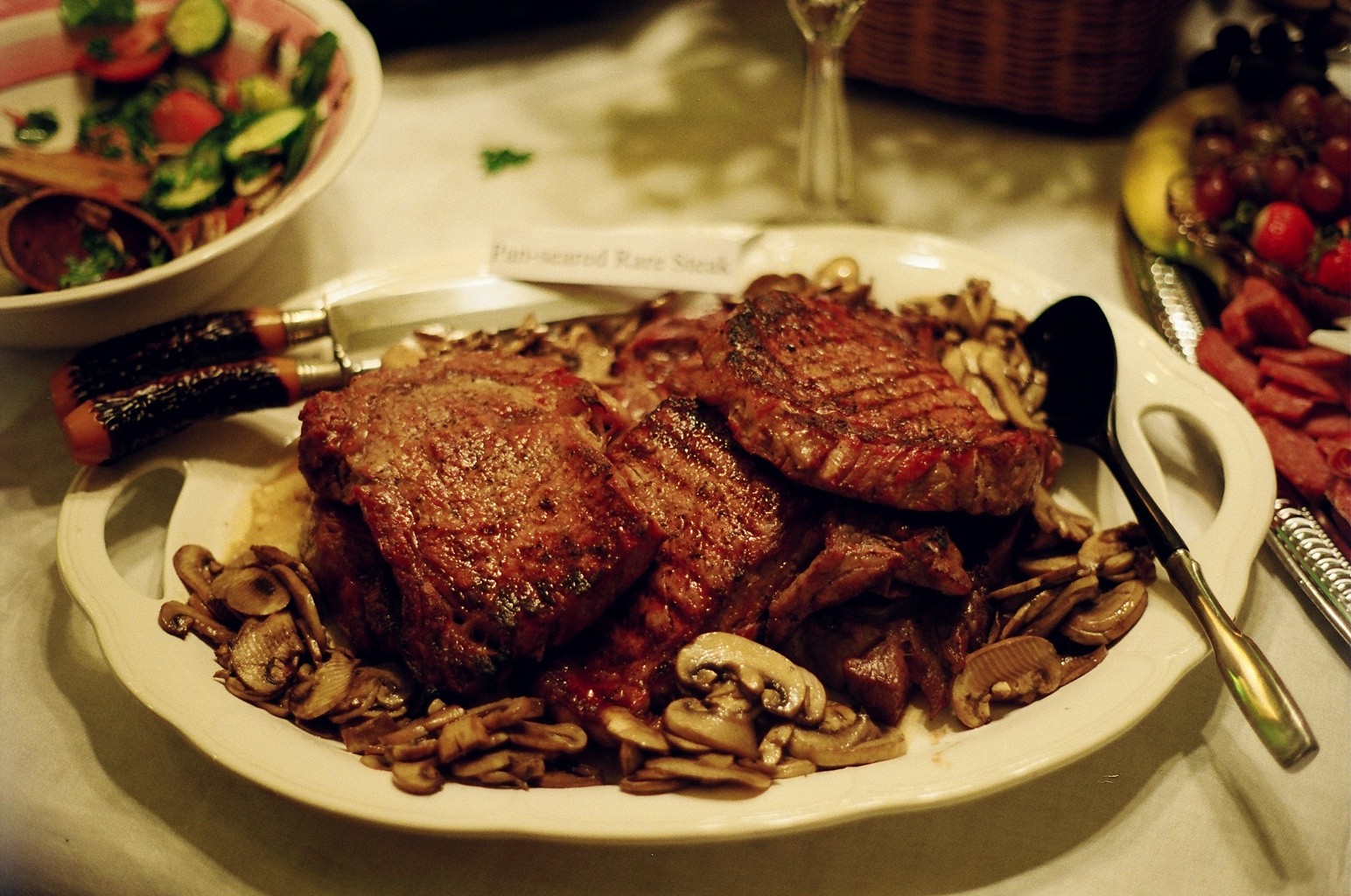
Here's one of Anthony's favorites from this movie: Pan-seared Rare Steak

One T-bone or Eye steak
1/4 tsp. salt
1 tsp. black pepper
2 large cloves garlic, minced
2 Tbsp. olive oil
½ onion, sliced
2-3 mushrooms, sliced

On a dinner plate, salt and pepper both sides of the steak; set aside. Over a medium flame, saute the garlic in the olive oil for a few minutes. Turn the heat to high, then add the steak to the pan. Cover and cook for 4-5 minutes on each side. At the last minute, add the onions and mushrooms. Cover and cook for a few minutes more. Serve immediately.
Yield: 2 servings


Monday, November 26, 2007

Introducing "Cooking with the Movies"

Following on the success of our previous collaboration, Cooking with the Bible, we have embarked on a new writing/cooking project: Cooking with the Movies: Meals on Reels. Some of our friends think we're crazy, but we seem to be called to cook! Or at least to entertain. And what better way to entertain than to combine performance (film) with eating (cooking)?

What will Cooking with the Movies be? Essentially, a cookbook and film guide, in which we will select 15-20 noted films and re-create the meals depicted therein. What were Leonardo di Caprio and Kate Winslet really eating in Titanic? Is it that difficult to make the timpano shown in Big Night? And where can one find the recipe for the life-changing chocolate featured in Chocolat? We'll also provide synopses of the films, an explanation of the importance of and context behind the meals, movie stills, and photos of each dish. Some of the other films we'll cover will include Goodfellas, What's Cooking?, Guess Who's Coming to Dinner?, My Dinner with Andre, Babette's Feast, Monsoon Wedding, and The Waitress.

On this blog, we will chronicle the process of creating and testing the recipes for Cooking with the Movies. As we select the films to include and put together the recipes, we will describe our successes and (perhaps) our almost-rans. Sometimes, the challenges are the most exciting part of writing a book--certainly the most interesting part of cooking!

We may share a recipe here and there as we go along, and we certainly welcome your feedback--after all, we need to know that our instructions are clear, and that any cook can reproduce what we've envisioned. You can comment on the posts here or email us directly. And don't forget to let us know if you have a favorite food film that you'd like us to include!

The finished book will eventually be available from Greenwood Press, and we'll keep you up-to-date on its availability.

Who are we? Anthony F. Chiffolo and Rayner W. Hesse Jr. are the authors of Cooking with the Bible: Biblical Food, Feasts, and Lore (visit www.cookingwiththebible.com for more information). They are also co-authors of We Thank You, God, for These: Blessings and Prayers for Family Pets. Anthony is editorial Director of Praeger Publishers. He is the author/editor/compiler of numerous books, including 100 Names of Mary: Stories and Prayers; Advent and Christmas with the Saints; Advent and Christmas Wisdom from Padre Pio; and At Prayer with the Saints. (The Rev. Dr.) Rayner W. Hesse, Jr., is pastor of St. John's Episcopal Church in New Rochelle, NY. He is the author of Jewelrymaking through History: An Encyclopedia and The Burning Question (forthcoming).

So please join us as we embark on this new adventure. We hope it's a delectable one!